Feeds:
Posts
Comments

Archive for the ‘Uncategorized’ Category

imrs-php

Time to put eggs back on the menu? (Deb Lindsey for The Washington Post)

The nation’s top nutrition advisory panel has decided to drop its caution about eating cholesterol-laden food, a move that could undo almost 40 years of government warnings about its consumption.

The group’s finding that cholesterol in the diet need no longer be considered a “nutrient of concern” stands in contrast to the committee’s findings five years ago, the last time it convened. During those proceedings, as in previous years, the panel deemed the issue of excess cholesterol in the American diet a public health concern.

The finding follows an evolution of thinking among many nutritionists who now believe that, for healthy adults, eating foods high in cholesterol may not significantly affect the level of cholesterol in the blood or increase the risk of heart disease.

The greater danger in this regard, these experts believe, lies not in products such as eggs, shrimp or lobster, which are high in cholesterol, but in too many servings of foods heavy with saturated fats, such as fatty meats, whole milk, and butter.

The new view on cholesterol in food does not reverse warnings about high levels of “bad” cholesterol in the blood, which have been linked to heart disease. Moreover, some experts warned that people with particular health problems, such as diabetes, should continue to avoid cholesterol-rich diets.

While Americans may be accustomed to conflicting dietary advice, the change on cholesterol comes from the influential Dietary Guidelines Advisory Committee, the group that provides the scientific basis for the “Dietary Guidelines.” That federal publication has broad effects on the American diet, helping to determine the content of school lunches, affecting how food manufacturers advertise their wares, and serving as the foundation for reams of diet advice.

The panel laid out the cholesterol decision in December, at its last meeting before it writes a report that will serve as the basis for the next version of the guidelines. A video of the meeting was later posted online and a person with direct knowledge of the proceedings said the cholesterol finding would make it to the group’s final report, which is due within weeks.
After Marian Neuhouser, chair of the relevant subcommittee, announced the decision to the panel at the December meeting, one panelist appeared to bridle.

“So we’re not making a [cholesterol] recommendation?” panel member Miriam Nelson, a Tufts University professor, said at the meeting as if trying to absorb the thought. “Okay … Bummer.”

Members of the panel, called the Dietary Guidelines Advisory Committee, said they would not comment until the publication of their report, which will be filed with the Department of Health and Human Services and the Department of Agriculture.

While those agencies could ignore the committee’s recommendations, major deviations are not common, experts said.

Five years ago, “I don’t think the Dietary Guidelines diverged from the committee’s report,” said Naomi K. Fukagawa, a University of Vermont professor who served as the committee’s vice chair in 2010. Fukagawa said she supports the change on cholesterol.

Walter Willett, chair of the nutrition department at the Harvard School of Public Health, also called the turnaround on cholesterol a “reasonable move.”

“There’s been a shift of thinking,” he said.

But the change on dietary cholesterol also shows how the complexity of nutrition science and the lack of definitive research can contribute to confusion for Americans who, while seeking guidance on what to eat, often find themselves afloat in conflicting advice.

Cholesterol has been a fixture in dietary warnings in the United States at least since 1961, when it appeared in guidelines developed by the American Heart Association. Later adopted by the federal government, such warnings helped shift eating habits — per capita egg consumption dropped about 30 percent — and harmed egg farmers.

Yet even today, after more than a century of scientific inquiry, scientists are divided.

Some nutritionists said lifting the cholesterol warning is long overdue, noting that the United States is out-of-step with other countries, where diet guidelines do not single out cholesterol. Others support maintaining a warning.

The forthcoming version of the Dietary Guidelines — the document is revised every five years — is expected to navigate myriad similar controversies. Among them: salt, red meat, sugar, saturated fats and the latest darling of food-makers, Omega-3s.

As with cholesterol, the dietary panel’s advice on these issues will be used by the federal bureaucrats to draft the new guidelines, which offer Americans clear instructions — and sometimes very specific, down-to-the-milligram prescriptions. But such precision can mask sometimes tumultuous debates about nutrition.

“Almost every single nutrient imaginable has peer reviewed publications associating it with almost any outcome,” John P.A. Ioannidis, a professor of medicine and statistics at Stanford and one of the harshest critics of nutritional science, has written. “In this literature of epidemic proportions, how many results are correct?”

Now comes the shift on cholesterol.
Even as contrary evidence has emerged over the years, the campaign against dietary cholesterol has continued. In 1994, food-makers were required to report cholesterol values on the nutrition label. In 2010, with the publication of the most recent “Dietary Guidelines,” the experts again focused on the problem of “excess dietary cholesterol.”

Yet many have viewed the evidence against cholesterol as weak, at best. As late as 2013, a task force arranged by the American College of Cardiology and the American Heart Association looked at the dietary cholesterol studies. The group found that there was “insufficient evidence” to make a recommendation. Many of the studies that had been done, the task force said, were too broad to single out cholesterol.

“Looking back at the literature, we just couldn’t see the kind of science that would support dietary restrictions,” said Robert Eckel, the co-chair of the task force and a medical professor at the University of Colorado.

The current U.S. guidelines call for restricting cholesterol intake to 300 milligrams daily. American adult men on average ingest about 340 milligrams of cholesterol a day, according to federal figures. That recommended figure of 300 milligrams, Eckel said, is ” just one of those things that gets carried forward and carried forward even though the evidence is minimal.”
“We just don’t know,” he said.

Other major studies have indicated that eating an egg a day does not raise a healthy person’s risk of heart disease, though diabetic patients may be at more risk.
“The U.S. is the last country in the world to set a specific limit on dietary cholesterol,” said David Klurfeld, a nutrition scientist at the U.S. Department of Agriculture. “Some of it is scientific inertia.”

***

The persistence of the cholesterol fear may arise, in part, from the plausibility of its danger.

As far back as the 19th century, scientists recognized that the plaque that clogged arteries consisted, in part, of cholesterol, according to historians.

It would have seemed logical, then, that a diet that is high in cholesterol would wind up clogging arteries.

In 1913, Niokolai Anitschkov and his colleagues at the Czar’s Military Medicine Institute in St. Petersburg, decided to try it out in rabbits. The group fed cholesterol to rabbits for about four to eight weeks and saw that the cholesterol diet harmed them. They figured they were on to something big.

“It often happens in the history of science that researchers … obtain results which require us to view scientific questions in a new light,” he and a colleague wrote in their 1913 paper.

But it wasn’t until the 1940s, when heart disease was rising in the United States, that the dangers of a cholesterol diet for humans would come more sharply into focus.

Experiments in biology, as well as other studies that followed the diets of large populations, seemed to link high cholesterol diets to heart disease.

Public warnings soon followed. In 1961, the American Heart Association recommended that people reduce cholesterol consumption and eventually set a limit of 300 milligrams a day. (For comparison, the yolk of a single egg has about 200 milligrams.)

Eventually, the idea that cholesterol is harmful so permeated the country’s consciousness that marketers advertised their foods on the basis of “no cholesterol.”

***

What Anitschkov and the other early scientists may not have foreseen is how complicated the science of cholesterol and heart disease could turn out: that the body creates cholesterol in amounts much larger than their diet provides, that the body regulates how much is in the blood and that there is both “good” and “bad” cholesterol.
Adding to the complexity, the way people process cholesterol differs. Scientists say some people — about 25 percent — appear to be more vulnerable to cholesterol-rich diets.

“It’s turned out to be more complicated than anyone could have known,” said Lawrence Rudel, a professor at the Wake Forest University School of Medicine.

As a graduate student at the University of Arkansas in the late 1960s, Rudel came across Anitschkov’s paper and decided to focus on understanding one of its curiosities. In passing, the paper noted that while the cholesterol diet harmed rabbits, it had no effect on white rats. In fact, if Anitschkov had focused on any other animal besides the rabbit, the effects wouldn’t have been so clear — rabbits are unusually vulnerable to the high-cholesterol diet.

“The reason for the difference — why does one animal fall apart on the cholesterol diet — seemed like something that could be figured out,” Rudel said. “That was 40 or so years ago. We still don’t know what explains the difference.”

In truth, scientists have made some progress. Rudel and his colleagues have been able to breed squirrel monkeys that are more vulnerable to the cholesterol diet. That and other evidence leads to their belief that for some people — as for the squirrel monkeys — genetics are to blame.

Rudel said that Americans should still be warned about cholesterol.

“Eggs are a nearly perfect food, but cholesterol is a potential bad guy,” he said. “Eating too much a day won’t harm everyone, but it will harm some people.”

***

Scientists have estimated that, even without counting the toll from obesity, disease related to poor eating habits kills more than half a million people every year. That toll is often used as an argument for more research in nutrition.

Currently, the National Institutes of Health spends about $1.5 billion annually on nutrition research, an amount that represents about 5 percent of its total budget.

The turnaround on cholesterol, some critics say, is just more evidence that nutrition science needs more investment.

Others, however, say the reversal might be seen as a sign of progress.

“These reversals in the field do make us wonder and scratch our heads,” said David Allison, a public health professor at the University of Alabama at Birmingham. “But in science, change is normal and expected.”

When our view of the cosmos shifted from Ptolemy to Copernicus to Newton and Einstein, Allison said, “the reaction was not to say, ‘Oh my gosh, something is wrong with physics!’ We say, ‘Oh my gosh, isn’t this cool?’ ”

Allison said the problem in nutrition stems from the arrogance that sometimes accompanies dietary advice. A little humility could go a long way.

“Where nutrition has some trouble,” he said, “is all the confidence and vitriol and moralism that goes along with our recommendations.”


Read Full Post »

fb_img_1478404024779

Read Full Post »

PLEASE WATCH! This is a video about the cancer industry….
To anyone who knows/knew someone with cancer, has cancer, had cancer, wants to not get cancer….or just wants to open their eyes to the reality of the cancer industry, this is a must see!

Read Full Post »

A new study has found evidence that brain tumours use fat as their preferred source of energy, bringing into question the decades-long assumption that sugar is their main fuel source.

If confirmed, this could fundamentally change the we treat cancer in the future, because until very recently, scientists have been focussing their efforts on ways to starve cancer cells of their sugar supply.

“For 60 years, we have believed all tumours rely on sugars for their energy source, and the brain relies on sugars for its energy source, so you certainly would think brain tumours would,” lead researcher Elizabeth Stoll, a neuroscientist from Newcastle University in the UK, told Ian Johnston at The Independent.

A glioma is a type of brain tumour that grows from glial cells – cells that support the neurons and help maintain the blood-brain barrier. Glial cells make up 90 percent of the brain’s total cells, and until recently have been shrouded in mystery.

There are three types of glial tumours – astrocytoma, oligodendroglioma, and glioblastoma – and they can be notoriously difficult to treat. Glioblastomas are the most common and most aggressive form, with just 30 percent of patients in the US living to more than two years after diagnosis.

A new target for treatments could make a huge difference, with Stoll and her team finding that when they inhibited the tumour cell’s ability to process fat as fuel, their growth rate slowed significantly, which equates to a better survival rate.

The team worked with human tumour tissue that had been donated by glioma patients undergoing surgery, and live mouse models of the disease, and treated them with a fatty acid oxidation inhibitor called etomoxir.

“We tested etomoxir in our animal model, and showed that systemic doses of this drug slow glioma growth, prolonging median survival time by 17 percent,” Stoll said in a press statement. “These results provide a novel drug target which could aid in the clinical treatment of this disease for patients in the future.”

The idea of cancer growth being fuelled by glucose – a simple sugar that healthy cells also break down to use as an energy source – has been around since at least the 1950s, when Nobel Prize-winning German scientist Otto Warburg observed that tumours primarily metabolised glucose in order to grow.

This process, known as the Warburg effect, and is now estimated to occur in up to 80 percent of cancers.

“It is so fundamental to most cancers that a positron emission tomography (PET) scan, which has emerged as an important tool in the staging and diagnosis of cancer, works simply by revealing the places in the body where cells are consuming extra glucose,” Sam Apple reports for The New York Times.

With so many cancers appearing to reply on glucose first and foremost for their growth, and healthy brain cells themselves also relying on sugar to keep functioning, it was only natural for scientists to assume that cancer cells in the brain would follow suit.

This perception was also perpetuated by the way scientists treat tissue samples in the lab.

As Stoll explained to The Independent, it’s common for researchers to extract brain tumour cells from patients and put them into blood to culture them in the lab. But the simple act of placing these cells into a medium where sugar is more abundant than fat appears to change them, prompting them to switch fuel sources and use sugar because they’re starved of fat.

Stoll’s team avoided this complication by culturing their mouse and human tumour cells in serum-free conditions.

“What we have always needed to do is put the cells in [blood] serum. It’s a trick to get the cells to grow in culture,” she said. “If you take malignant brain tumours and expose them to blood serum, it changes them. Then they switch quite easily.”

We should make it clear that Stoll’s discovery has so far only been made in animal models and extracted human brain tumour cells, so until the team can demonstrate similar effects from the drug etomoxir in human trials, we can’t jump to any conclusions.

The researchers also say they’re not ready to make any assumptions about how our diets could be implicated in the fat versus sugar debate at this stage.

But any new target for cancer research is something to be cautiously optimistic about, because if anything is going to allow us to finally beat the enigma that is cancer, it’s going to be a better understanding of what fuels its relentless growth.

The results have been published in Neuro-Oncology.

Read Full Post »

Examines the profound claim that most, if not all, of the degenerative diseases that afflict us can be controlled, or even reversed, by rejecting our present menu of animal-based and processed foods…

WATCH FREE HERE:

http://www.beautiful-vegan.com/2013/11/watch-forks-over-knives-documentary-for.html

Read Full Post »

cancer-in-kids-3

No ailment or symptom is too small when it comes to our children, especially when you consider that some of them may be subtle warning signs of cancer. Early detection could mean saving a child’s life and this begins with knowing the common signs of malignancy or the presence of cancer. Here are the cancer signs in children that you should not overlook. (From theAsianparent)

Children may get nosebleeds due to their thin blood vessels at the front portion of their nose, which will gradually thicken after puberty.But if a child experiences frequent nosebleeds up to four or five times a month, this might be a red flag for cancer.According to National University Hospital in Singapore, frequent and persistent nosebleeds are a symptom of Acute Lymphoblastic Leukaemia (ALL), which is the most common type of cancer seen in children.

Kids are active and may get the occasional cut here and there when playing sports or other vigorous activities.But another symptom to watch out for are sores that don’t seem to heal and persist. The sores can be on any part of the body which are difficult to heal, such as sores on the skin, penis, vagina, or oral cavity. These should be dealt with promptly and should not be overlooked.

Painless, enlarged lymph nodes could be a sign of Non-Hodgkin Lymphoma. Lymphoma is caused by tumours that start in the lymph glands and the symptoms include swelling in the neck, armpit, groin, chest and abdomen – all regions where the lymph glands are located.Lymph nodes which are close to the surface of the body – such as on the sides of the neck, in the groin, armpits, or above the collar bone – can be easily seen or felt as lumps under the skin.

If a child is losing weight without trying or without any changes in diet or exercise, parents should definitely schedule a doctor’s appointment.Children can lose weight if they are not consuming enough calories, or are burning more calories than usual, but when they start to lose a lot of weight quickly, it could be a sign of an underlying illness, including cancer, according to medical experts.

Shortness of breath or difficulty in breathing is a serious symptom in children which warrants a visit to the doctor’s office or the emergency room.Shortness of breath may be one of the cancer signs in children that you might overlook. According to the National University Cancer Institute, Singapore, shortness of breath could be a sign of childhood leukaemia, which accounts for almost 40% of all childhood cancers in Singapore.

Another sign of cancer is the presence of a mass, usually in the abdomen or extremities.KK Women’s and Children’s Hospital states that swelling in the abdomen could be indicative of Wilms’ tumour, a kidney cancer that occurs in very young children.

Pay attention if you notice that your child is behaving unusually, as this could be a sign that something isn’t right.According to the Children’s Medical Institute of the National University Hospital, this could be a sign of cancer, along with changes in personality and school performance.

Persistent headaches could also be a sign of a tumour in the brain, according to the National Cancer Centre Singapore (NCCS). This is typically caused by an increased pressure in the skull that is caused by the mass, as the skull is a bony structure which cannot expand.

A child may be vomiting due to various reasons, such as food poisoning, severe cough or cold, or the stomach flu.But cancer that affects the brain can also cause vomiting, says the NCCS. If your child is frequently nauseous and has trouble holding in his food or water intake, it could be more than just a stomach bug and you should get it checked out immediately.

The NCCS adds vision problems such as blurring, double vision or loss of vision as a possible indicator of a brain tumour. If your child is showing signs of difficulty in sight, it may be time to consult with a specialist to rule out the possibility of cancer.

According to Parkway Cancer Centre, among the list of cancer signs in children are seizures, specifically those that are not related to or caused by high fevers. These, too, could be symptoms of a brain tumour.Seizures can also be due to a fever, lack of oxygen, head trauma or other illnesses, so it’s best to seek medical advice to determine the cause.

The National Cancer Institute, Singapore adds bone pain to the list of cancer signs in children, sometimes even causing a limp.More specifically, this could be indicative of Neuroblastoma, a cancerous tumor that commonly occurs in the adrenal gland.It is a malignant solid tumour which produces swelling or pain and the symptoms may vary depending on the location of the tumour.

The Health Promotion Board mentions that persistent fatigue and weakness are common symptoms of Lymphoma, which is a group of cancers of the lymphatic system.Tests that need to be done to diagnose this include: Physical exam, blood test, biopsy of the swelling, bone marrow aspiration, X-rays, CT or MRI scans.

If your child has a recurrent and unexplainable fever, this could be a sign of cancer, or specifically Leukaemia, according to KK Women’s and Children’s Hospital (KKH).Leukaemia is the most common type of cancer seen in children which occurs when the marrow overproduces immature white blood cells.

Wilm’s tumour, which is a cancer that occurs in the kidney, may cause a child to pass blood in his urine, according to KKH.This rare type of cancer mainly affects children and is usually found in just one kidney, although occasionally it may affect both kidneys.


Read Full Post »

10441501_10152660961406512_9167321347392107392_n

Read Full Post »

For 10 long years, well-known Japanese doctor and medical pioneer Toshiki Fukutsudzi fought to develop a method to prevents bad posture. She became famous in her homeland, gaining widespread attention after publishing her book on how to overcome bad posture, combat back problems and strengthen one’s abdominal muscles. Her best-selling book has sold over six million copies throughout Asia.

Dr. Fukutsudzi specializes in treating patients with problems in their pelvic bone and her method is also said to reduce fat around the waist.

I always take these kinds of “treatments” with a grain of salt, careful not to take them too seriously. This method however has gained such popularity that I cannot help but feel tempted to at the least try it out.

Obviously, for serious or extended back issues, I would say, see your doctor. But otherwise, why not give this a shot? After all, it’s extremely easy and only takes 5 minutes.

Here’s how it works:
Roll an ordinary towel to form a thick and stable “sausage”. Wrap it with some tape or string so that it stays put. Lay down on your back on a flat and hard surface – beds and couches are too soft. Place the towel at the height of your navel, where your spine begins to curve.

höjd-600x281

Once you’re in the correct position, place your feet shoulder-width apart, with your toes pointing inward toward each other. Stretch your arms above your head, palms down, with your pinkies touching. Lay still in this position for 5 minutes. The exercise may feel a bit painful at first, but try to hold for 5 minutes — it does get easier every time you do it.

höjd1-600x281

For best results, repeat the exercise 3 times a day for a few weeks.

dårskap-600x230

The method may strike you as too simple to actually produce results, but as I said, I think you have nothing to lose, so feel free to experiment. I know in any case that I will! Please share the method with your friends if you know someone who suffers from back problems.

Read Full Post »

arthritiss-780x410

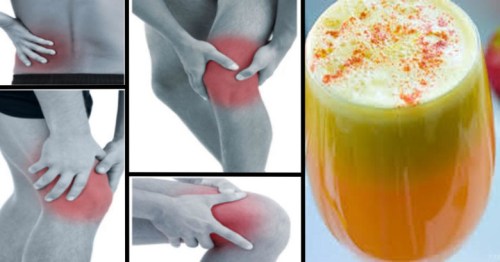
Unfortunately, it is common for older adults to feel pain in the knees, legs, back, and ankles.

Especially, this is common for people who spend most of the day sitting, or have an inactive lifestyle.

Many different conditions can lead to painful joints including rheumatoid arthritis, osteoarthritis, gout, bursitis, sprains, strains, etc.

In most of the cases of back pain, it will heal with time – around 50 percent of patients will feel relief from pain within two weeks, and around 90 percent within 90 days, regardless of the treatment.

However, people who suffer from chronic back pain may find it difficult to lead their everyday life, finding it hard to stand, sit, or even lie down.

The pain in legs often results from wear and tear, constant standing, injuries in the joints and bones, or in ligaments, muscles, tendons, etc. Also, poor circulation can lead to leg pain

Pain relief smoothie

Ingredients
– One orange
– Two cups of pineapple
– One lemon
– Two celery stalks
– One inch fresh ginger root (or 1 tablespoon ginger powder)
– Two inches of fresh turmeric root (or 2 tablespoons turmeric powder)
– A quarter teaspoon black pepper
– One teaspoon of coconut oil

Instructions

Peel the orange and lemon as well as ginger and turmeric (if you use them fresh). Chop and core the pineapple. Put all of the ingredients in a blender, and blend at high speed.

Serve and drink it immediately.

Using a blender will ensure that dietary fiber stay within the juice. If you use a juicing machine, the dietary fiber will be filtered out as waste.

Studies have found that people who eat a diet rich in vitamin C and dietary fiber have lower amounts of C-reactive protein levels in their bodies. C-reactive proteins are inflammation markers that have been linked to disease like rheumatoid arthritis, diabetes, and heart disease.

What each ingredient does

Orange. Muscle cramps are also a common cause of leg pain, which often occur by overuse of muscles or low calcium or potassium levels. Research shows that getting the right amount of vitamin C aids in preventing inflammatory arthritis and maintaining healthy joints.

Pineapple. The active component found in pineapple known as bromelain is effective in relieving joint pain and reducing inflammation associated with arthritis. There are some evidence that this enzyme have anti-inflammatory and pain-relieving effects compared to non-steroidal anti-inflammatory drugs (NSAID).

Lemon. Lemon also contains vitamin C as well as vitamin E, which are powerful antioxidants. These vitamins protect the cells from free-radical damage and helps to build and maintain collagen and connective tissues.

Celery. Celery is rich in vitamin K. Low levels of this vitamin can result in abnormal cartilage and bone mineralization.

Ginger. The active compound in ginger known as gingerol has the ability to fight prostaglandins, inflammatory compounds that trigger pain.

Turmeric. A 2009 study published the Journal of Alternative Complementary Medicine showed that the active ingredient in turmeric, curcumin relieved pain and improved function in knee osteoarthritis equally to ibuprofen. Additionally, in a 2006 study turmeric extract was found to inhibit joint inflammation and periarticular joint destruction.

Source: webmd.com spine-health.com arthritis.org

Read Full Post »

111

This cure was made by the Bulgarian scientist, Professor Dr. Hristo Mermerski, and many consider it to be a revolutionary remedy that has cured thousands of cancer-sufferers. The remedy contains all the essential vitamins, mineral salts, proteins, bioactive substances, carbohydrates and vegetable fats. “It’s a food that treats the entire body, and the cancer in such an organism simply disappears”, Prof. Mermerski has said in his lectures.

This incredible, homemade remedy cleanses the blood vessels, cures the heart, boosts the immune system, cleanses the liver and kidneys. It also improves memory, protects your heart from suffering a heart attack and it’s the best natural remedy against all types of cancer.

The Recipe

Ingredients:

15 fresh lemons
12 fresh garlic cloves
35 oz. natural honey
14 oz. sprouted grains ( green wheat)
14 oz. fresh walnuts
How to make sprouted grains:

Put the green wheat in a big, glass bowl. Pour water to cover them and leave them overnight. After 12 hours, drain the grains, rinse them and again drain (strain through gauze). Put the drained wheat in a bowl and let it stay for 24 hours. After 24 hours, you’ll get sprouted grains.

Instructions:

Grind the walnuts, sprouted wheat and the previously cleaned, garlic cloves. Grind 5 lemons with their crust and then add them to the sprouted wheat mixture. Squeeze the other 10 lemons and add the lemon juice to the mixture. Mix the ingredients until you get a homogeneous mixture.

Add the honey and stir with a wooden spoon. Put the mixture in glass jars and place them in the fridge. Let it stay in the fridge for 3 days before using it.

How to Consume the Remedy

Take 1-2 tbsp. 30 minutes before breakfast, dinner and before going to bed. If you use the remedy to treat cancer, take 1-2 tbsp. every 2 hours.

Dr. Mermerski says that this remedy helps you have a long, healthy life, cures cancer and keeps your body youthful and energetic.

“This remedy contains all essential vitamins, mineral salts, bioactive substances, proteins, carbohydrates and fats. It improves the work of your organs and glands and keeps your body healthy. No cancer can survive in a healthy body,” explains Dr. Mermenski.

Read Full Post »

« Newer Posts - Older Posts »